


Year 9 Options - For Key Stage 4 Year 10/11
Year 9 Options 2025
The Year 10 and Year 11 curriculum is different from the national curriculum students have been studying since they started in school. Students will shortly be deciding not only some of the subjects that they will be studying, but also in some cases the type of qualification they will gain. It may be GCSEs or other technical/vocational qualifications.
It is very important that students read the Options Booklet carefully, discuss it with family, friends and teachers and research the courses that will suit student’s interests and style of learning. It is important that students get their choices right and pick courses that they both enjoy and will help them achieve the best possible grades. Students should also consider their progression routes and future career options.
Students will all follow a core curriculum of compulsory examined subjects. This includes GCSE subjects in English Language, English Literature, Mathematics, Combined or Separate Sciences and Religious Studies. Physical Education also forms part of the core curriculum and some students may choose to take a GCSE or Cambridge National Level 2 course in this subject.
Students will then have the choice of a further three GCSE subjects, or a combination of GCSE subjects and other technical/vocational qualifications. The booklet contains a full list and description of each available option course and guidance on making choices.
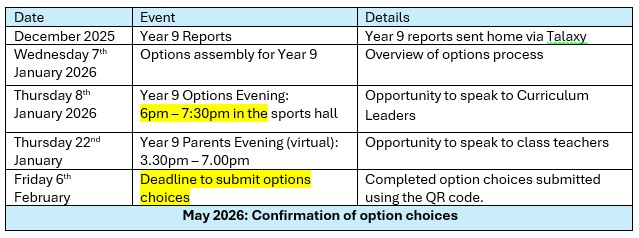
Options Deadline: Friday 6th February 2026
Please use the QR code at the back of the Options Booklet to submit the form.
Options: Common Questions & Answers
Below are some specific FAQ which may help answer many of the queries you have about the Options process in general, the number of GCSE subjects taken nationally, the relationship between GCSE subjects and grades with Further and Higher Education.
How many GCSE subjects do Three Rivers Academy students take?
A student starting Year 10 in September 2026 will be entered for the following number of GCSEs:
- 8.5 if studying Combined Science
- 9.5 if studying Separate Science
How many GCSE subjects do you need to do A Levels?
Most sixth-forms or colleges in the UK (including Three Rivers Academy) require students to have passed a minimum of 5 GCSEs to apply for their courses (remember that English Language and English Literacy count as two separate GCSEs, Math’s is double-weighted, Combined Science is the equivalent of two GCSEs and Separate Science is equivalent to three GCSEs.
Additionally, students normally need to sit certain subjects to gain access to related A-levels. For instance, students will be required to have taken the French GCSE to enter the French A-level course. However, there are many A-level courses that you can access without a GCSE in the subject; for example, at Three Rivers Academy, you may be able to study Business Studies, Sociology, or even Geography or History even if you do not have a GCSE in that subject.
Please click here for a list of our September 2026 Sixth Form courses and GCSE requirements.
How many GCSE subjects do you need for university?
A minimum of 5 GCSE subjects is essential to access university. Nevertheless, this can vary depending on the university and the course you want to access. Therefore, we recommend that you do research based on your desired career path.
UCAS references from TRA Sixth Form also explicitly reference the approach to Key Stage Four at Three Rivers Academy along with the average number of GCSE subjects taken.
How many GCSE subjects do you need for Oxford and Cambridge?
Technically, there are no set GCSE requirements to enter Cambridge or Oxford, but the average accepted candidate has passed eight exams with grades 8 or 9. Keep in mind, however, that your GCSE performance will be considered in the context of a series of interviews and UCAS points
Do GCSE subjects count towards UCAS points?
GCSEs do not provide UCAS points, as they are considered Level 2 certifications. Only Level 3 qualifications (A-levels and equivalent) score UCAS points. These will depend on the subject you choose and the grades you achieve. However, some universities will take GCSE results into account when considering offers; the higher your grades, the more competitive your application will be.
Should I study Separate or Combined Science?
Everyone must study Biology, Chemistry and Physics at GCSE level. At Three Rivers Academy this can be either as Combined Science (equivalent to two GCSE subjects) or as Separate Science (equivalent to three GCSE subjects). Both routes enable students to progress to A Levels in Science providing they meet the A- level criteria.
Separate Science shares many of the taught components with Combined Science but also has extra subject content to enable an extra GCSE to be awarded. In lieu of this, we ask that Separate Science students have a compulsory P6 every week to ensure that the content is covered fully.
Students who opt for Separate Science are students that enjoy Science as a subject; they may or may not wish to study science further than GCSE, but they are happy to extend their knowledge and skills in science beyond the combined Science curriculum.
Students also often find that the content of the Separate Science course is more interesting as it delves more into more depth with the human body, explores topics such as space and students can develop greater practical skills such as titrations, none of which are covered in the Combined Science curriculum.
Note that Separate Science has greater and more in-depth content and prepares students for A-Levels a little more than Combined Science.
There is no difference in the difficulty between Combined and Separate Science as the grades awarded are parallel and students can sit both foundation or higher tier in both routes. One of the main advantages of the Separate Science course is that we can interchange the tiers. A student may be better in Biology and Physics than Chemistry. For example, a student could sit Biology and Physics at higher tier and Chemistry at foundation tier. This would mean that a student could get the following grades: Biology: 7, Physics: 6, Chemistry: 4. This is because each Science is a separate GCSE, and we can approach each student as an individual that has strengths in particular subjects when it comes to selecting tiers.
In Combined Science we do not have as much latitude to cater for specific strengths as all papers must be sat at the same tier (either Higher or Foundation). The six papers are totalled by the exam board, and a grade is awarded based upon their cumulative score. The same student as outlined above then might gain a 6-6 or a 6-5 in Combined Science.
Should my child study an EBaac subject?
We encourage everyone to study a modern foreign language and / or a humanities subject. These subjects can provide a greater range of choices when applying for sixth form.
A reminder of the key dates in relation to the Options process: